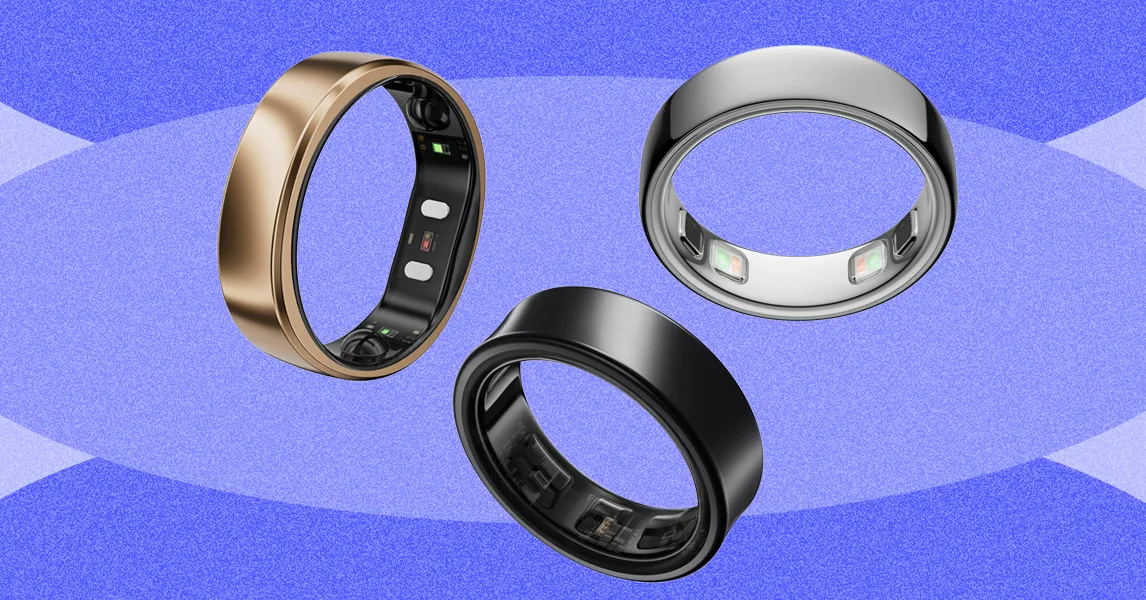
Why WIRED recommends: Former WIRED editor Adrienne So found this ring’s accuracy similar to the Apple Watch Ultra. It accurately auto-detected workouts—even pool workouts—and the heart rate tracking is also reliable. Its cycle-tracking feature, powered by the fertility-tracking app Natural Cycles, uses skin-temperature sensing to track when your period will come—and it works.
It comes in an attractive, clear charging case with an LED that shows you how much battery life you have left.
The trade-offs: While you can use the Galaxy Ring with most Android phones, it costs about as much as the Oura Ring 5 upfront and doesn’t require a subscription. The most useful features, like your daily Energy Score and wellness tips (what the company calls Booster Cards), also rely on Galaxy AI, which means you’ll only be able to see them if you are using the ring with an Android phone and the Samsung Health app. Lastly, Adrienne found the Galaxy Ring to be a bit too generous with its sleep tracking, which makes sense since it lacks a gyroscope.
TL;DR: If you have a Samsung phone and Galaxy Watch, the Samsung Galaxy Ring has an Apple-like seamlessness and interoperability to it. Read Adrienne So’s full review here.
More Smart Rings We’ve Tested
Over the years, the WIRED Reviews team has tested several other entrants in this category. Here are some more smart rings to consider.
Oura Ring 4 for $349: While the Ring 5 is the smallest smart ring on the market, the Ring 4 is still slimmer and lighter than its predecessor. There’s also a ceramic version. Reviewer Simon Hill had issues with dwindling battery life and some scuffing with his silver Ring 4, but he hasn’t encountered those issues with the ceramic version.

Photograph: Simon Hill
Leep Ring for $199: A British smart ring that’s affordable and subscription-free, and offers simplified stats on your activity, sleep, and stress. Unfortunately, sleep is woefully inaccurate and tends to report that I’ve been asleep for my entire time in bed, even if I was watching TV or reading. One night, it suggested I slept 8 hours and 43 minutes (Oura said 6 hours and 52 minutes). The app could also use some polish. For example, it doesn’t take into account that it’s only a couple of hours into the day before telling me my movement for today is “Bad.” I also lost data on the first night it ran out of battery, and there was no warning notification to tell me to recharge. A fully charged ring is meant to last up to eight days, but I’ve been getting closer to five. —Simon Hill
RingConn Gen 2 for $299: Despite being $100 more than the Gen 2 Air, this is still a relatively affordable, subscription-free smart ring. The main differences here are that the Gen 2 offers sleep apnea monitoring and it’s a titanium build; the Gen 2 Air is made of stainless steel.
Avoid These Smart Rings
Amazfit Helio Ring: Amazfit is a purveyor of affordable fitness trackers like the Active 2, so I expected its smart ring to be competitive, but the Helio falls short in several areas. I like the textured bronze finish, but it is the only color you get. Sizes are limited to 8, 10, or 12 for now (sizes 7 to 13 are coming). Also, the Helio was often inaccurate, with heart rate measurements wildly out of step with other wearable tech. It lacks automatic workout tracking, battery life averaged three days for me, and it frequently disconnected from the busy and confusing Zepp app. There’s no monthly subscription fee, but there is Aura AI ($70/year) for sleep insights and content or Fitness ($30/year), which includes an AI coach. They are expensive and confusing. (Why have two separate subscriptions?) The Helio works much better in conjunction with a smartwatch (I tried it with the Amazfit Cheetah Pro), as it can merge the data, but as a stand-alone device, it is impossible to recommend. —Adrienne So
Movano Evie Ring: When the subscription-free Movano Evie Ring first came out, it was touted as the fitness tracker for women’s health. However, its menstrual health features are pretty underbaked compared to those offered by its competitors. Now that the Oura and the Galaxy Ring can track cycles accurately, this ring’s time may have passed. It’s also currently sold out.

