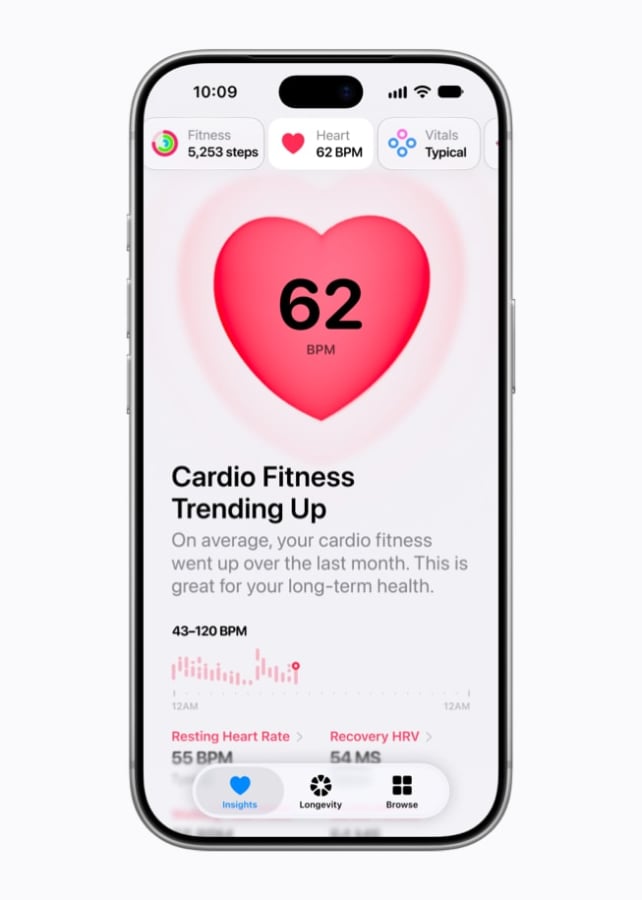
Apple wants its Health app to do more than collect biometric data. Its next job is helping users understand what those numbers could mean for their day.
During its Sept. 9 fall event, the company debuted the Apple Watch Series 12 and Apple Watch Ultra 4, both anchored by an upgraded Health Sensing System. But the hardware primarily serves as an on-ramp for a major software shift: an Apple Intelligence-driven overhaul of the Health app coming to iOS 27 and iPadOS 27.
For years, Apple Health acted as a passive digital filing cabinet. The upcoming redesign changes that approach by using health and activity data with Apple Intelligence to generate personalized summaries and recommendations.
A new daily readiness score on the Series 12 and Ultra 4 synthesizes recent activity, sleep scores, and vitals into a single rating from 0 to 10. The interface pairs that rating with plain-language daily guidance: Recover, Pace Yourself, Ready, or Go For It. Apple says the score is designed to help users decide whether to prioritize recovery or take on more activity that day.
In the companion Longevity tab, an algorithm computes “Health Age,” comparing an individual’s biometric trajectory, such as VO2 max, resting heart rate, and heart rate variability, against their chronological years.
“By combining breakthrough sensing on Apple Watch with Apple Intelligence in the Health app, we’re able to translate complex biometric data into clear guidance for users,” said Dr. Sumbul Desai, Apple’s vice president of Health.
Apple is also expanding into preventive health assessments and optional laboratory testing. An on-device movement evaluation uses the iPhone camera and Apple Watch to grade balance, strength, and mobility without sending video to the cloud. Users can also order a 50-biomarker blood panel directly from Quest Diagnostics for $119 at roughly 2,000 U.S. locations, with results such as A1c and LDL measurements available through the Health app.
Must-read Apple coverage
The prescriptive coaching pivot
Apple’s software transformation reflects a broader shift from descriptive health tracking toward personalized wellness coaching.
By translating complex biometric trends into simpler guidance, Apple is directly challenging consumer longevity platforms and wellness trackers. Turning multiple health and activity signals into a daily prompt could make the information easier for mainstream users to interpret.
Yet assigning an single score to human physical recovery is inherently reductive. Daily readiness hinges on messy lifestyle realities like medication, emotional strain, or irregular work schedules that consumer optical sensors cannot fully isolate. Although simplified scores may motivate healthier routines, they could also cause unnecessary anxiety if users treat an algorithmic estimate as a medical judgment. Users should regard the scores as wellness indicators rather than diagnoses, particularly when they conflict with symptoms, medication guidance, or advice from a health professional.
Availability and requirements
Consumers eager to access these capabilities face distinct hardware barriers.
- The redesigned Health app arrives later this year, initially in U.S. English. Its Apple Intelligence features require a compatible iPhone or iPad.
- The readiness score requires the hardware-specific Health Sensing System found exclusively on Apple Watch Series 12 (starting at $399) and Ultra 4 (starting at $799).
- Health Age requires an Apple Watch, though Apple has yet to publish a definitive list of compatible older generations.
- The broader watchOS 27 update arrives Monday, Sept. 14, requiring an Apple Watch Series 9, SE 3, Ultra 2, or later, paired with an iPhone 11 or later running iOS 27.
Before upgrading, users should determine which features require a new Apple Watch and which will reach existing devices through software. The larger test will be whether Apple’s simplified scores help people make better daily decisions without encouraging them to place too much confidence in estimates that cannot account for every medical or lifestyle factor.

