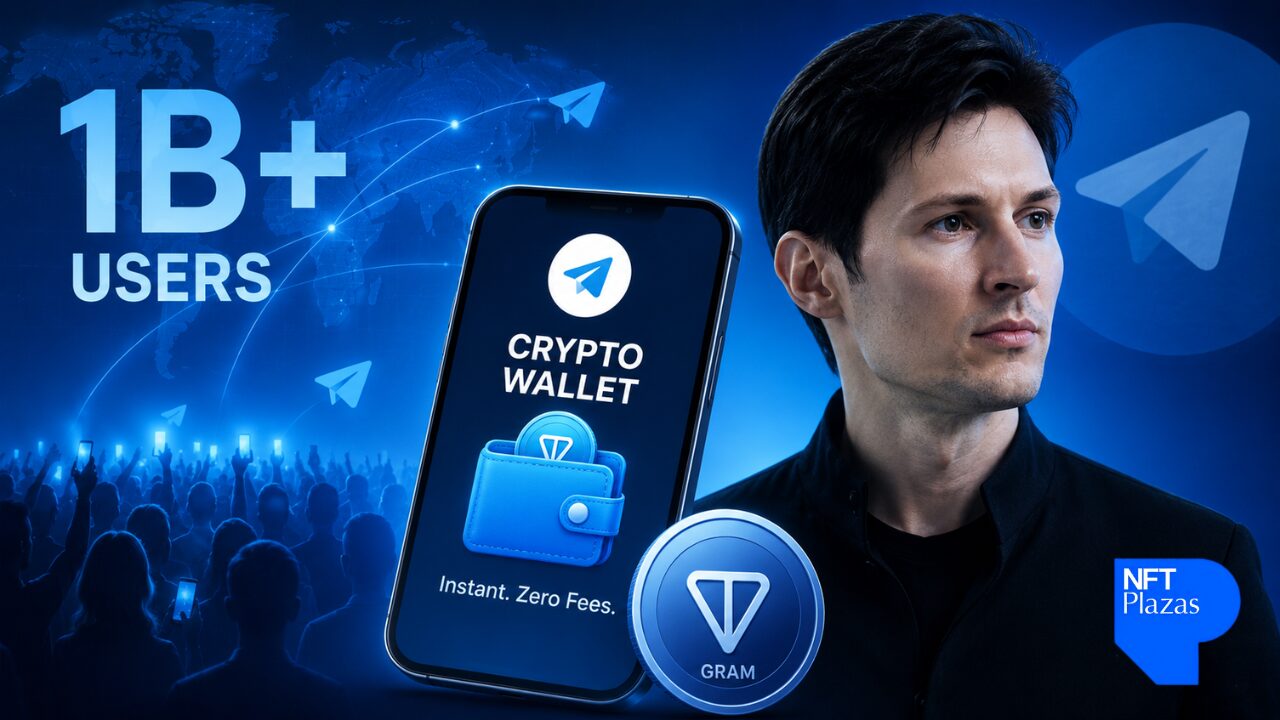
Telegram is preparing what could become the largest cryptocurrency onboarding initiative ever attempted. Founder and CEO Pavel Durov has announced plans to integrate a native non-custodial crypto wallet directly into every version of Telegram, giving the messaging platform’s more than one billion monthly active users access to instant, zero-fee cryptocurrency transfers.
The announcement, made on Durov’s official Telegram channel on July 21, marks another major step in Telegram’s strategy to embed blockchain technology into its messaging ecosystem. If delivered before the end of the summer, the rollout could significantly expand the adoption of self-custody wallets beyond the traditional crypto audience.

Pavel Durov Wants to Give a Billion Telegram Users a Native Crypto Wallet
Native wallet coming to Telegram
According to Durov, Telegram will introduce a native non-custodial Gram wallet integrated into every version of the app, eliminating the need for users to search for and activate a separate wallet service.
Durov described the launch as “the largest rollout of a non-custodial crypto wallet in human history,” adding that users will be able to send cryptocurrency instantly with zero transaction fees.
The move represents a major evolution of Telegram’s existing crypto services. Today, users can access Wallet in Telegram through the @wallet bot, which has surpassed 150 million registered accounts. However, that product is operated by The Open Platform (TOP), an independent company rather than Telegram itself.
The upcoming wallet also differs in how it manages users’ assets. While the existing wallet primarily uses a custodial model—where a third party controls private keys unless users opt into self-custody—the new wallet is expected to be non-custodial by default, giving users direct ownership of their private keys and funds.
Telegram has yet to confirm whether the native wallet will replace the existing @wallet bot or operate alongside it. It also has not disclosed which cryptocurrencies will be supported beyond Gram.
Bringing self-custody to the mainstream
A non-custodial wallet allows users to control their own private keys instead of relying on an exchange or third-party service to safeguard their assets.
This means funds cannot be frozen or transferred without the owner’s permission. However, users are also responsible for securing their recovery credentials, making wallet security a key consideration.
While self-custody has long been considered a core principle of cryptocurrency, it has often been too complicated for mainstream users. By embedding wallet functionality into a messaging app used by more than one billion people, Telegram could dramatically lower the barriers to crypto adoption.
The scale is unprecedented. Popular self-custody wallets such as MetaMask have tens of millions of users, but none has launched with access to Telegram’s global audience.
Reviving the Gram vision
The wallet announcement follows Telegram’s renewed commitment to The Open Network (TON) ecosystem.
In June, the network’s native token officially changed its name from Toncoin (TON) back to Gram (GRAM) after an 81% community vote. The blockchain itself continues to operate as The Open Network, while only the token’s branding was updated.
The rebrand restored the original name envisioned by Telegram when it introduced its blockchain project in 2018 and signals the company’s growing involvement in the ecosystem once again.
From SEC lawsuit to comeback
Telegram’s blockchain ambitions began in 2018, when the company raised approximately $1.7 billion from private investors to develop the Telegram Open Network and its original Gram token.
The project was halted after the U.S. Securities and Exchange Commission (SEC) alleged the token sale was an unregistered securities offering. In 2020, Telegram settled the case by returning approximately $1.2 billion to investors and paying an $18.5 million civil penalty before officially stepping away from the project.
The blockchain survived under community development as The Open Network, with Toncoin serving as its native token. Telegram has since resumed a leading role in the ecosystem, culminating in the token’s rebrand back to Gram and the planned native wallet integration.
GRAM jumps on the announcement
The market responded positively to Durov’s announcement.
GRAM climbed roughly 7% after the news, recovering above $1.50 following a sharp decline throughout much of July. Even so, the token remains well below its previous highs.
Its all-time high of around $8.25 was recorded during Telegram’s tap-to-earn gaming boom in June 2024, while its most recent peak of approximately $2.89 came in May 2026 after Telegram announced its renewed leadership of the network.

GRAM Price Performance (Source: CoinMarketCap)
A milestone for crypto adoption
If Telegram delivers the wallet as planned, it could fundamentally change how everyday users interact with digital assets.
Instead of downloading a separate crypto application or opening an exchange account, users could send cryptocurrency as easily as they send a message. Creators, merchants, and businesses would also gain access to a global payment network capable of instant, zero-fee transactions inside one of the world’s largest messaging platforms.
Several details remain unknown, including the exact launch date, supported assets beyond Gram, and how Telegram will simplify key management for newcomers. Even so, integrating a self-custody wallet into an app with more than one billion users would represent one of the most ambitious attempts yet to bring cryptocurrency into everyday digital life.

