Other Slushie Machines I Liked

Photograph: Matthew Korfhage
GreenPan
Frost Slushie Machine
The slushie machine from Belgian-founded wellness brand GreenPan is maybe the only slushie machine I’d describe as being even slightly attractive, or pleasant on a countertop—available in a trendy pistachio color scheme that a 21-year-old co-tester called “cute.” The slush produced by this device also had quite a nice consistency, perhaps due to a tighter auger around the cylinder that roiled the slush a little more. My colleague Martin Cizmar, who also tested this device, was able to recreate a Philly recipe for Italian-style water ice with Meyer lemons, and declared himself an unending fan.
The GreenPan slushed admirably, making a full chamber’s worth of spiked slush in about 25 minutes. This is nowhere near as fast as the XL or the Twist on slushing speeds, alas. The fill chamber is a little shallow, which means you have to pour slowly or you’ll make a mess. If you accidentally leave the handle down, you’ll also make a mess. Some reports online of cracks in the cylinder over use are also reason for pause. But if aesthetics are a prime consideration, this will slush handily. And look a little better while doing it.
-
Photograph: Matthew Korfhage
-
Photograph: Matthew Korfhage


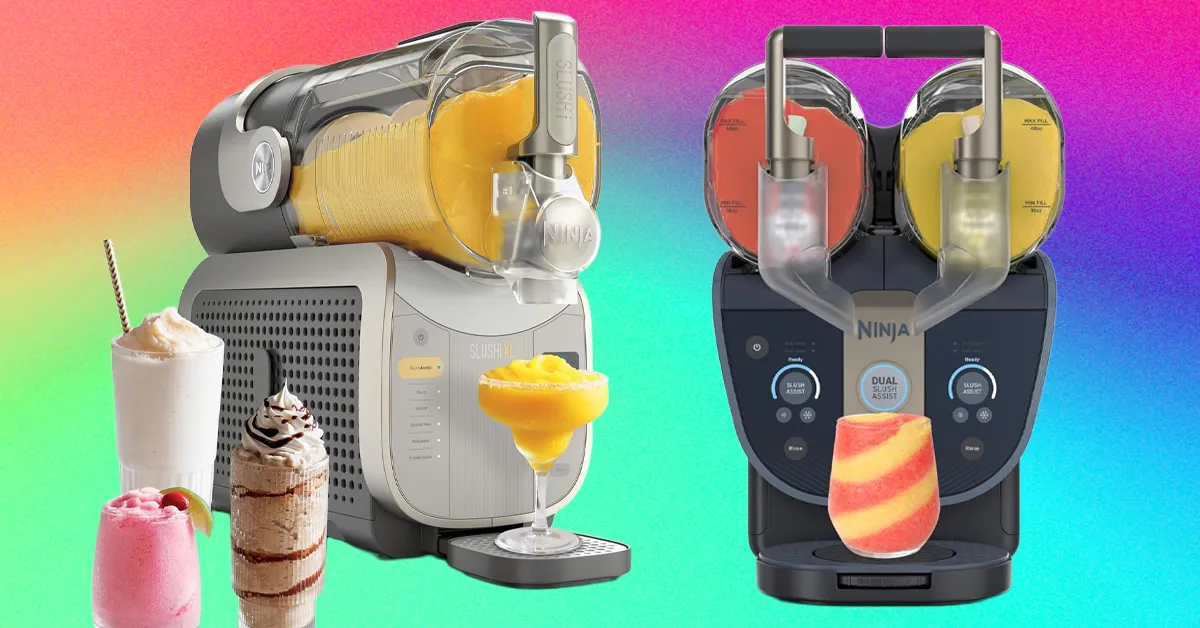
The original Ninja Slushi was quite simply a triumph of industrial design when it arrived in 2024—the machine that managed to bring the cocktail bar or convenience-store slushie to the home kitchen countertop. Among many imitators, Ninja’s original design remained the most user-friendly and reliable until the next-generation Ninjas supplanted it.
I’ve made coconut-lime daiquiris for a family of visiting Brazilians, who joked that they planned to take the machine back with them on the airplane. I’ve entertained a party full of children with the nonalcoholic version of slushie. And I’ve made silly frozen cocktails at home, whether lime Jarritos slushies or tamarind michelada slushies. Everything frozen is better, it turns out. Freezing a cocktail adds fun and removes shame.
But it’s been replaced. I consider the original Slushi a good value model, but it’s no longer the top of the market. The original Slushi doesn’t slush as well on higher-alcohol slushies as the newer XL and Twist, even for ABV below 16 percent. (Really, with an OG Ninja Slushi, the sweet spot is around 10 to 12 percent ABV if you want good consistency.) Milkshakes/soft-serve are not really feasible on the original Ninja either, always either foamy or ice-gritty.
Which is all to say, buy the Slushi when it’s on a good sale at $250 or less—or when it’s updated with a compressor as good as the one on the XL or Twist.
Other Slushie Machines Tested
Ever since Ninja took slushies to the home market, the Amazon directories have filled with newer brands you’ve likely never heard of and whose names sometimes seem subject to a randomizer engine: Inoviva, Chivalz, Vibofrost, Friwest, Aekda, Syintao, Vischic, Ranvaira, Rinvotio, and the list goes on. Most are available at discounts compared to Ninja or other more recognizable brands.
I’ve tested three such brands: Chivalz, Invoviva, and Vibofrost. All three have had one form of reliability issue or another: basic design defects, inconsistency of performance, or simply disappearing from the market.
Chivalz Slushie Machine (no longer in stock): This was previously WIRED’s budget pick, which my co-tester Kat Merck called, without insult, “a quite respectable Ninja Slushi knockoff.” The device arrived with a welcome digital temp readout and a removable back panel that made cleaning easier on the slush chamber. Performance was comparable to the original Ninja, though the user interface was a bit janky. But since last year, the brand’s slushie machines seem to have disappeared, as the brand’s focus moved to air purifiers and humidifiers.
Vibofrost Slushie Machine ($235, sold out after Prime Day): This Vibofrost, like the Chivalz, freezes slushies comparably to the original Ninja Slushi. And like the Chivalz, it has a somewhat irritating child-lock feature, and a timed feature that seems of limited utility. Though it will slush within around 20 to 30 minutes, the oddly designed spout can spray wildly if there’s any liquid in the machine, the drip tray does not attach securely, and it kinda moans like a dying tauntaun while in operation.
Inoviva Slushie Machine for $120: I tested this Inoviva slushie machine twice. The first time, the device registered much louder than competitors, the drip tray arrived stuck to the machine, and the compressor began to fail after a week’s testing. The second time, it was still loud, and the user interface had a difficult-to-navigate locking feature, but freezing was indeed more consistent. The inconsistency in quality control makes this device difficult to recommend. But maybe you’re willing to brave this for a steeply discounted price. The Inoviva also has one terrific feature: The ability to adjust thickness for each drink setting.
My co-tester Kat Merck (on the now-discontinued Chivalz) and I made so very many slushies with each machine, from dairy to nondairy to coffee slushies to straight-up bottles of wine. Specifically, we tested every version of slush that a machine advertised. If Ninja or GreenPan says a machine can make frappés and milkshakes and frozen juices, we made frappés and milkshakes and frozen juices, tinkering where necessary. I froze orange juice and strawberry juice, slushed a bouquet’s worth of rosé, and made slushies from daiquiri to margarita to whiskey Coke. I slushed tamarind micheladas (an excellent idea) and Twisted Tea (a terrible idea).

Photograph: Kat Merck
I also raced the freezing capabilities of all three machines by pouring a 16-ounce can of delicious Mango Mike’s Harder Lemonade in each, then seeing which machine was fastest. (For the XL, I used a 24-ounce can.) And I made smooth and dense coconut-lime daiquiris with coconut milk, according to Ninja’s recipe, to test how well each machine’s dispenser handled a genuine dense-textured challenge.
How Do Home Slushie Machines Work?
The tech is pretty simple, almost ingeniously so: A beefy cylindrical freezing core in the center of the drink chamber continually cools any liquid in contact with it. It’s encircled by a plastic spiral auger attached to a motor. The auger mixes the drink, keeps it slushing instead of freezing solid, and also pushes the resulting slush toward the dispenser nozzle so you can have some. The resolute simplicity of this design allowed Ninja and others to scale down the commercial slushie maker for home consumers thirsty for frozen treats.
The main requirement is that the frozen beverage have more than 4 percent sugar—or between 3 percent and 16 percent alcohol—in order to lower the freezing point of the resulting concoction and make slushing possible. Some slushie machine vendors recommend percentages more like 15 percent sugar, for perfect consistency. But I often balk at this. Coca-Cola and orange juice are each around 11 percent sugar—so that’s very sweet. Some hero of the internet has made a slush calculator for easy reference.
A minimum of 16 ounces of liquid is required for most 88-ounce home machines, for simple reasons: The liquid needs to be in physical contact with the core in order to slush up and also to keep ice from forming on the central cylinder’s surface. The Slushi XL requires a 24-ounce minimum, because it’s bigger.
Can You Put Diet Soda in a Slushie Machine?
No and yes. Slushies rely on a helpful property of water: Sugar (or salt) dissolved in water lowers its freezing point below 32 degrees Fahrenheit. Why? Solubles like sugar are chaos agents. Sugar molecules move randomly, refuse to dissolve into ice, and interfere with water’s ability to form hydrogen bonds and turn crystalline. Some water molecules freeze, but sugar water doesn’t. Tada! Slush.
If you try to make a slushie out of sugar-free soda, or sugar-free anything, ice crystals will instead form easily. The stainless steel freezing core will ice over and scrape on the auger, and ice cubes or hunks will gather mass in the slushie machine. The cylinder will start to shake, then the machine will clunk, then eventually you’ll probably break your machine: Low-sugar fail-safes on these devices have not been overly reliable, alas. So don’t try this at home!
This doesn’t mean you’re doomed to massive calories if you want to make a slushie. Not every artificial sweetener lowers the freezing point appropriately, but the one that Ninja recommends for diet slushies is allulose, a rare but naturally occurring sugar that’s 70 percent as sweet as basic sugar but is not metabolized effectively by the human digestive system. This means it’s low in calories and doesn’t cause insulin spikes—but as with a lot of indigestibles, note that side effects can include bloating or GI distress for some.
For easiest use in a slushie, buy liquid allulose. Powdered versions also exist, but to use them, you’ll need to make a simple syrup by heating up the powder in water to help it dissolve, then let it cool. If you just try to drop the allulose powder into your machine with some Diet Coke, it might not dissolve, and you might still get ice formation. Or at least, I definitely still got ice formation when I tried this on the OG Ninja, and had to stop my machine.
How Can You Stop Milkshakes From Getting Foamy in a Slushie Machine?
Bet you didn’t expect a lesson in milk proteins today! But here’s the deal: Milk proteins start to separate when agitated. Churning milk is, in fact, how butter gets made. Proteins separate out, and you get butter on the one side and buttermilk on the other. Both are delicious, but neither is wanted in a milkshake.

Photograph: Matthew Korfhage
If you try to make a milkshake in a churning slushie machine using just milk, you’ll eventually start to see the effects of these milk proteins separating out from buttermilk—which will manifest first as an undesirable foaminess. To avoid this, Ninja recommends also adding heavy cream or half-and-half to any milkshake recipe. The higher fat content will keep things smoother.
Note it’s easiest to use fruit syrups, rather than just juice, and add vanillin, or it’ll be a bit boring: The heavy fat tends to overwhelm any subtle fruit flavors. Another deep secret of the tasty milkshake? Salt. Add a tiiiinny pinch; it’ll help bring out flavor. A 16-ounce McDonald’s milkshake has 260 milligrams of sodium—about 1/16th of a teaspoon of table salt, or approximately the amount that fits between your index finger and your thumb.
But temper your expectations here. None of the slushie machines we tested made a texture comparable to a classic milkshake. On most machines, which don’t have compressors as powerful as the new-model Ninjas that are now our top picks, the texture is often a little ice-gritty and not as richly textured or integrated as the milkshake you’ll get from your local burger joint, let alone the soft serve from the famously broken ice cream machines at McDonald’s. Slushie machines also can’t handle chunks of frozen fruit, often the best part of a milkshake.
On the newer Ninjas, with their more powerful freezing power, I was able to get the smoothness and freeze I wanted. But because most recipes call for a high-fat mix of 2:1 milk and heavy cream in order ot avoid churning foam and butter, the results still weren’t quite a light milkshake. It was more like a dense, rich, quite tasty soft serve.
Now, do I like being able to make 20-minute soft-serve in my home? From milk and heavy cream and sugar and a dash of vanilla? Heck yes, I do.

