
Key Takeaways
- JPMorgan estimated bitcoin’s annualized volatility at 55%.
- Bitcoin’s estimated correlation with U.S. large-cap stocks was 33%.
- Unstable correlations kept bitcoin outside JPMorgan’s main portfolio models.
Bitcoin Forecast Leads Grayscale’s Institutional Assessment
Grayscale Head of Research Zach Pandl said Nov. 4 that bitcoin’s inclusion in JPMorgan Asset Management’s 2027 long-term investment assumptions marked another institutional milestone. The research evaluated the cryptocurrency alongside established investments, giving portfolio managers estimates for its returns, volatility, and relationships with other holdings. Pandl focused on how those characteristics could support diversification.
Pandl wrote:
“Its projected 10% compound annual return exceeds estimated returns for all other asset classes, while its estimated correlation with US large cap stocks is just 33%—below international equities, corporate bonds, and hedge funds.”
JPMorgan’s long-term return projections, released Oct. 19, included 7.5% for U.S. large-cap equities and 9.8% for private equity. A 60/40 stock-bond portfolio carried a projected annual return of 7%, providing another comparison with the bitcoin estimate. The broader research covered more than 200 major asset classes over a 10- to 15-year horizon, using data as of September. Its assumptions informed strategic allocations and assessments of investment trade-offs.
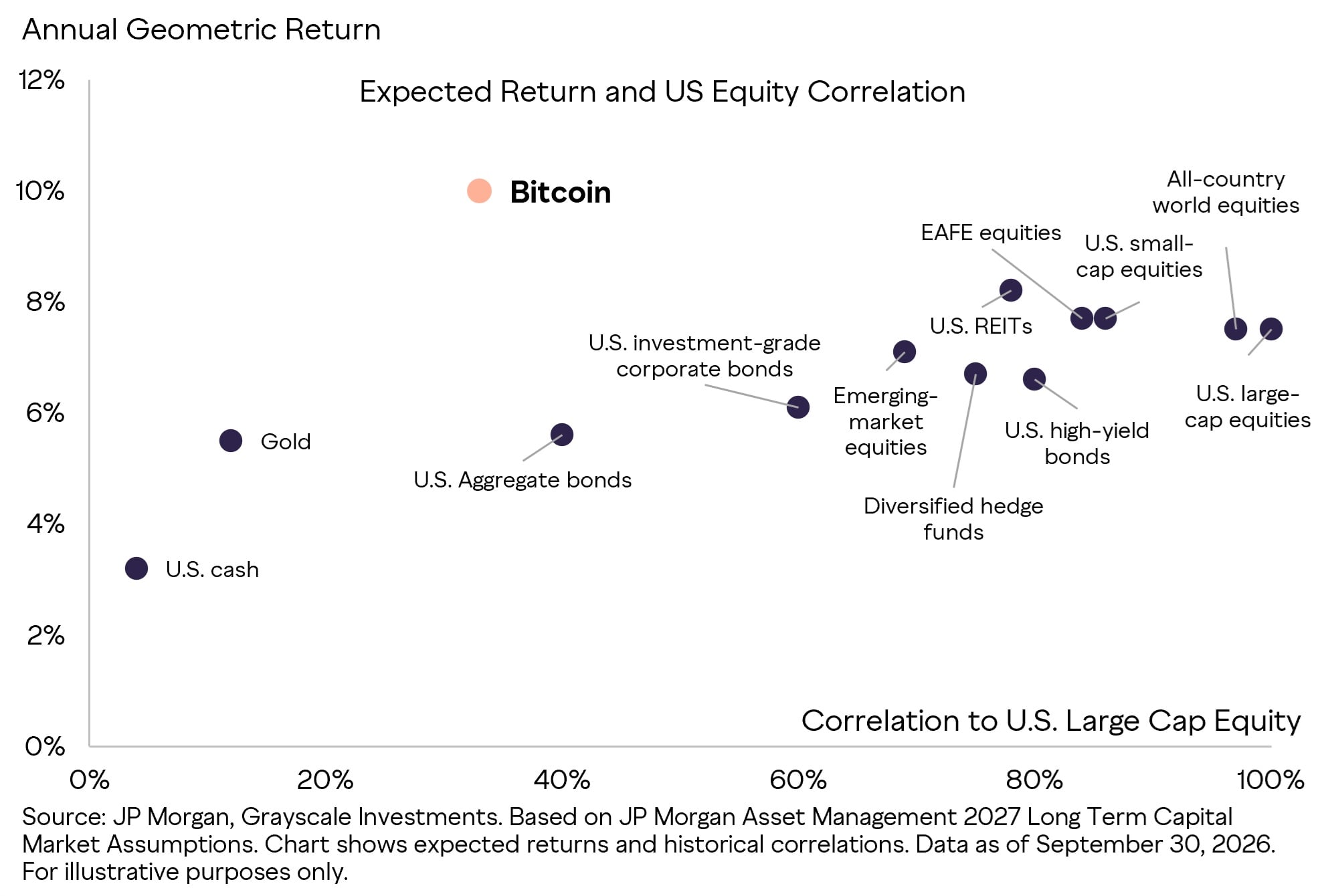
The chart combines projected returns with historical correlations using data as of Sept. 30, 2026. Gold showed a lower correlation with U.S. large-cap stocks than bitcoin, alongside a lower expected annual return of 5.5%.
Volatility Complicates Bitcoin’s Portfolio Role
The 55% annualized volatility assumption accompanied JPMorgan’s caution about unstable correlations with other assets. The firm kept bitcoin outside its main covariance matrices, tables used to assess how investment returns move together. Such instability complicates estimates of how a bitcoin position could affect the overall risk of a portfolio.
JPMorgan’s assessment described bitcoin’s investment characteristics as speculative and associated its portfolio role with monetary easing. Its authors identified adoption, regulation, and liquidity among the factors affecting its economics. They also highlighted the challenge of forecasting an asset whose fundamentals differ from investments supported by cash flows.
Grayscale used JPMorgan’s assumptions to illustrate potential portfolio benefits, while acknowledging that their realization depended on future returns and asset relationships. Pandl’s assessment emphasized the combination of high absolute returns and comparatively low correlation with core equities. The firm’s analysis left bitcoin’s portfolio role dependent on how those characteristics evolve.
Wealth Managers Set Different Allocation Limits
Blackrock described a 1% to 2% bitcoin allocation as a potential complementary diversifier in June, meaning a holding that could spread risk by behaving differently from other investments. Its analysis compared that range’s contribution to portfolio risk with exposure to major technology stocks. Larger bitcoin positions could substantially increase overall risk, the firm cautioned.
Bank of America (NYSE: BAC) supported a 1% to 4% digital-asset allocation in December 2025 for suitable clients comfortable with elevated volatility. The guidance covered digital assets broadly and emphasized regulated investment vehicles. It covered the bank’s Merrill wealth management business, Bank of America Private Bank, and Merrill Edge online investing platform.
For advisors implementing crypto exposure, Grayscale launched four model portfolios on Sept. 14, offering suggested investment mixes built from crypto exchange-traded products. The models used market-cap weighting and quarterly rebalancing, while advisors retained responsibility for client allocations. Each strategy capped an individual asset’s weighting at 40%, limiting its share of the model’s allocation.