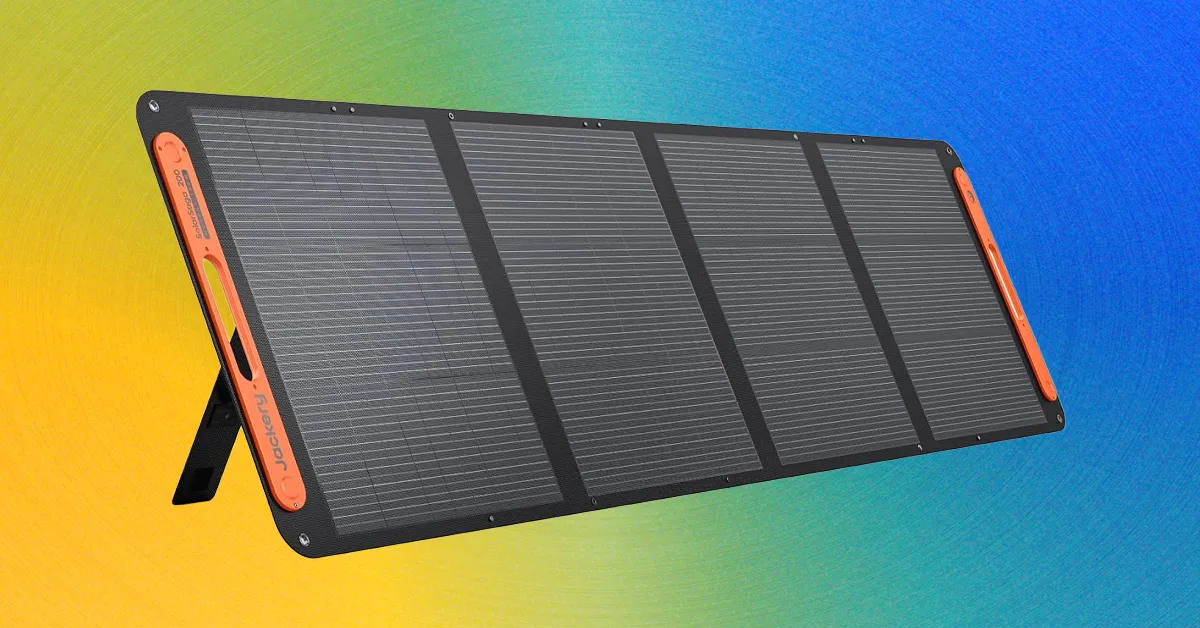
The 350-W panels are fairly easy to set up, though the metal fasteners on the kickstands take a bit of fiddling. Unfortunately, the 500-W panels are downright finicky. To fold down compactly, it is broken into 12 separate sections and folds out in a double row, so I found I had to wrestle with it to get the feet set up and ensure it was stable. You’ll also need to watch out at the higher angle if there’s any wind, or a gust might just catch them and flip them over. The flip side is that they fold down impressively small with a nice rubbery handle that makes them easy to carry. Setup aside, I don’t think you’ll find anything more compact for the wattage.
Lightweight and flexible, this panel is ideal for mounting on top of your RV, van, or other vehicle. You could attach it to a cabin roof or a hardtop tent too, and it can bend up to 270 degrees. Though no fixings are included, it’s possible using adhesive or strong double-sided tape, and it also has holes for bolting. It’s thin, weighs just shy of 9 pounds, and boasts an IP68 rating. Conversion efficiency is 25 percent, and I was able to get 165 watts out of it when the sun was at its highest. Now, it’s not really all that portable, in that it doesn’t fold up or have a handle for easy carrying. But it’s a great option for mounting and has standard MC4 connectors. BougeRV also offers a smaller 100-W model.
Other Good Solar Panels I’ve Tried
Anker Solix PS200 for $450: I have tested several of Anker’s older solar panels, including the Solix PS200. These folding 200-watt panels are IP67-rated with a familiar design of molded plastic handles, folding feet, and metal fasteners. They offer 23 percent conversion efficiency and couldn’t quite hit the same highs as the Solar Saga 200 despite a higher price and weight. The reason you might pick Anker instead is the inclusion of MC4 connectors and an XT60 connector cable. Anker has just released some superior-looking bifacial panels, both PS100 ($220) and PS200 ($500), but I haven’t tested them yet. They appear more compact and efficient.
DJI IBC Power 200W for $419: DJI sent me these panels, and they have the same slide-out folding feet with a strap and metal fasteners, though the molded handle is only at one end. They are IP67, came with an MC4 to XT60 cable, and produced up to 160 watts when the sun was out. Sadly, you need the DJI Power Solar Panel Adapter Module (MPPT) to use them with some DJI power stations, though they worked fine charging the Anker Solix C1000.
What I Plan to Test Next
The last EcoFlow panel I tested seems to be discontinued, but the latest 220W panel ($299) looks good and is reasonably priced. I haven’t been able to test any Renogy panels, but they seem to be highly rated in online reviews. Two other brands on my radar are Goal Zero and Biolite.
Portable Solar Panels: Frequently Asked Questions
What to Look For in Solar Panels
Portable solar panels come in all sorts of shapes and sizes, but they always have a stated maximum wattage they can produce. While a panel might be rated at 200 watts, it’s important to note that it will likely produce less in real-world conditions. Changing weather, the angle of the sun, the impact of temperature, and other factors can reduce the wattage your panels produce. Even in good conditions, you may only get 70 to 80 percent of the stated wattage, and it will be a lot less in challenging conditions. Solar generators will also have a stated maximum wattage that they can absorb through the solar charging port.
For portability, most panels fold up into a kind of briefcase design for easy carrying. They are generally rigid with fold out feet to prop them at different angles. You can also get flexible panels, like the BougeRV panel I recommend above that’s designed to be attached to an RV roof. There are also roll-up panels, though these tend to be less durable. Make sure you check the dimensions and weight of your chosen panels before buying.

Photograph: Simon Hill
Lastly, always check the compatibility of your panels and your solar generator. It’s simplest to match panels and generators from the same manufacturer, but it’s easy to mix and match panels with generic MC4 connectors and solar generators with XT60 ports. It’s important to be careful about the voltage of your panels relative to your solar generator to avoid dangerous mishaps. Look for the open circuit voltage (OCV) for both and make sure your panels never exceed your solar generator’s range. People will sometimes overpanel, adding a higher wattage than the generator can accept to account for the fact that the panels will likely never produce their full capability. This is usually safe to do, provided you don’t exceed the OCV.

Photograph: Simon Hill
You should also favor solar generators with Maximum Power Point Tracking (MPPT), a technology designed to monitor the fluctuating input from solar panels (impacted by shade and changing weather) and maximize how much of it is converted for use.
What About Weather Protection?
Most portable solar panels are designed to be left outdoors and survive a light rain shower. Look for an ingress protection (IP) rating. An IP65 rating is fine for light rain and dust, but if you want your panels to survive more serious weather, look for an IP67 or IP68 rating. While the panels and cables are generally weatherproof, be careful with your solar generator and make sure it has an IP rating if you intend to leave it outside.
I try to test portable solar panels in similar conditions using the same solar generator where possible (usually the Anker Solix C1000). I test in direct sunlight and also in partial shade. I record the highest wattage and check how much power each solar panel can produce over four and eight hour periods. I try to test every day for a week or so, weather permitting, and then compare results.
Power up with unlimited access to WIRED. Get best-in-class reporting and exclusive subscriber content that’s too important to ignore. Subscribe Today.

