Key Takeaways
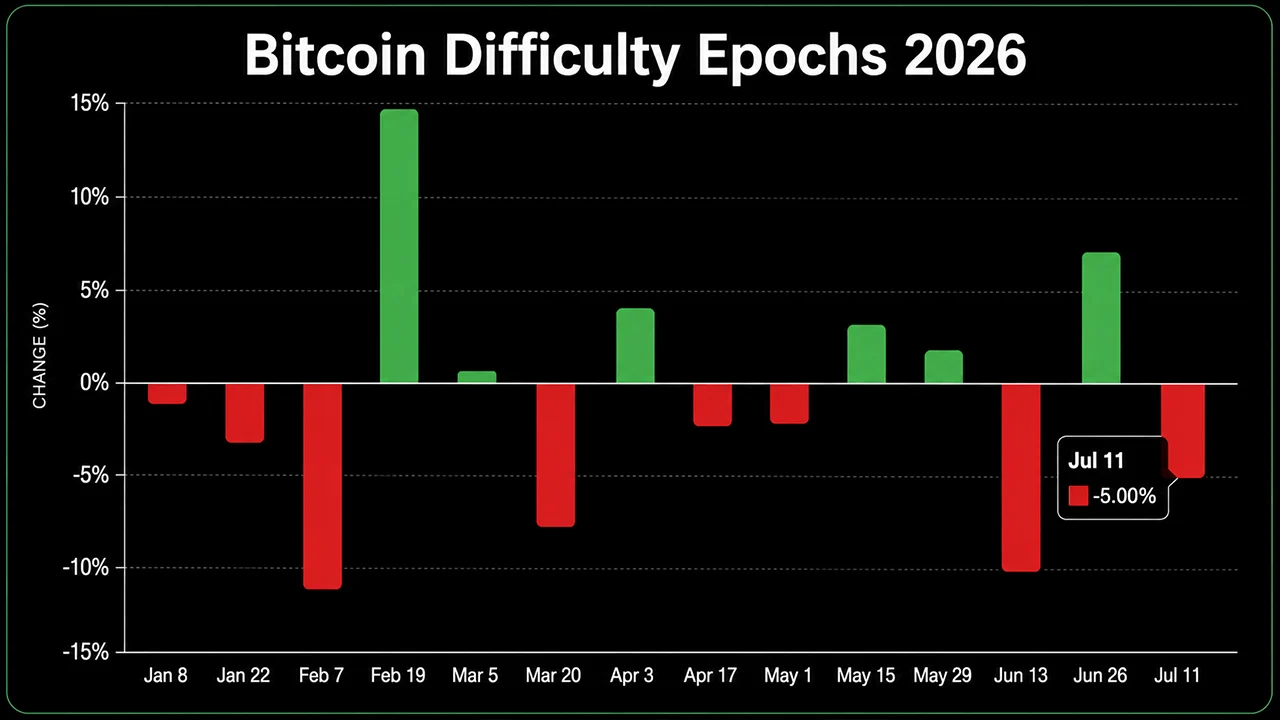
- Bitcoin difficulty fell 5% to 127.17 trillion on July 11, its 14th adjustment of 2026.
- Hashrate dropped 7.9% in ten days to 908 EH/s, driving the difficulty cut.
- Hashprice rose 12.5% to $31.1 per PH/s but stayed 37.2% below its October 2025 peak.
The adjustment landed at block height 957600. Difficulty moved from 133.87 trillion to 127.17 trillion, a decline of roughly 6.70 trillion. The change took effect at 4:09:11 p.m., based on the block timestamp. The prior epoch ran about 14 days, 18 hours, and 9 minutes, longer than Bitcoin’s 14-day target for 2,016 blocks. That pace works out to an average block time of 10 minutes, 32 seconds, about 5.1% slower than the protocol’s 10-minute target. The 5% cut brought the network back toward that target.
A Year Defined by Wide Swings
Eight of the 14 difficulty adjustments so far in 2026 have been negative and six positive. The average adjustment was negative 0.87%, but the average absolute move was 5.30%, a gap that points to sharp back-and-forth activity hiding behind a mild-looking average. Compounded from the difficulty in place before the first adjustment on Jan. 8, the network has dropped approximately 14.22%. The July 11 reading ranks as the third-lowest of the year, behind only June 13’s 124.93 trillion and Feb. 7’s 125.86 trillion.
Hashrate Slides Toward Its 2026 Range
The seven-day average hashrate via hashrateindex.com stood near 908 EH/s on July 11, down about 14.8% from the Jan. 1 level of roughly 1,065 EH/s. That figure sits about 21.3% below the one-year peak of 1,154 EH/s reached in October 2025, and just 3.3% above the 2026 low of 879 EH/s set in early February.
The most recent drop happened fast. Hashrate was near 986 EH/s on July 1 and fell to about 908 EH/s by July 11, a decline of roughly 7.9% in ten days. That pullback slowed block production and fed directly into the 5% difficulty cut.
Hashprice Climbs but Stays Deeply Discounted
Hashprice, the expected revenue miners earn per petahash per second, closed near $31.1 on July 11. That marks a recovery of about 12.5% from the $27.6 level seen around July 1, but the metric remains down roughly 16.4% since Jan. 1 and about 37.2% below its one-year high of $49.4, reached in late October 2025. The 2026 low of $27.2 came in early June.
How Difficulty, Hashrate, and Hashprice Fit Together
Difficulty is a lagging measure. It does not track hashrate directly, but it reacts to how fast the previous 2,016 blocks were mined. When hashrate falls, blocks slow, and difficulty drops at the next adjustment. Lower difficulty then raises the expected revenue for each unit of hashpower still running, which can lift hashprice if Bitcoin’s price and fee income hold steady.
The June-to-July stretch shows the mechanism in motion. Hashprice bottomed near $27.2 in early June. Difficulty fell 10.09% on June 13. Hashrate then returned and difficulty rose 7.15% on June 26. Hashrate weakened again, and difficulty fell another 5% on July 11, with hashprice ending the period at $31.1.
All three measures have traced a pattern of lower highs in 2026. Difficulty peaked at 146.47 trillion on Jan. 8 and has not come close since, topping out near 138.97 trillion in April and 133.87 trillion in June. Hashprice peaked at $49.4 in October 2025, then $41.8 in January, then $39 in May. Hashrate peaked at 1,154 EH/s in October 2025, 1,087 EH/s in late February, and has struggled to hold 1,000 EH/s since.
What It Means for Miners and Traders
Each recovery in hashrate and hashprice has fallen short of the one before it. Difficulty relief has softened the blow for miners still operating, but it has not been enough to restore hashprice to earlier levels. For traders, the pattern points to a mining sector adjusting to tighter margins rather than one in a single sustained pullback. Effective computing power has repeatedly returned to a band between roughly 880 and 910 EH/s before rebounding, though it remains unclear whether that range marks a durable floor or another stop on the way lower.

