Every currency has a founding myth. Bitcoin has a founding accusation. On 3 January 2009, Satoshi Nakamoto embedded a headline in Bitcoin’s first block. “The Times 03/Jan/2009 Chancellor on brink of second bailout for banks.” Now all eyes are on the $80Bn Satoshi Wallet.
The standard reading is a timestamp, proving the chain was not pre-mined. True, and trivial: any front page proves a date. But Satoshi chose the one announcing that Britain was rescuing its banks for the second time in four months.
That word, second, does the work. One bailout is an emergency; two is a pattern. It says rescue is not the system’s exception but its feature: privatized profit, socialized loss, institutions leveraged on assets nobody could price, secure in the knowledge that failure was underwritten.
The Mysterious "Patoshi" Miner
Every great mystery has its clues.
For Bitcoin, one of the most intriguing lies hidden in plain sight, recorded forever on the blockchain for anyone to examine.
It is the story of a miner who may have accumulated one of the greatest fortunes in… pic.twitter.com/xHlIAYSUb2
— Caffè Satoshi (@CaffeSatoshi) July 5, 2026
Satoshi Wallet: Bitcoin Rests on a House of Cards Now More Than Ever
“The Times 03/Jan/2009 Chancellor on brink of second bailout for banks.”
Every design choice inverts a bailout precondition: fixed issuance against discretionary money creation, a bearer asset against chains of counterparty claims, payments made, as the whitepaper opens, “without going through a financial institution.”
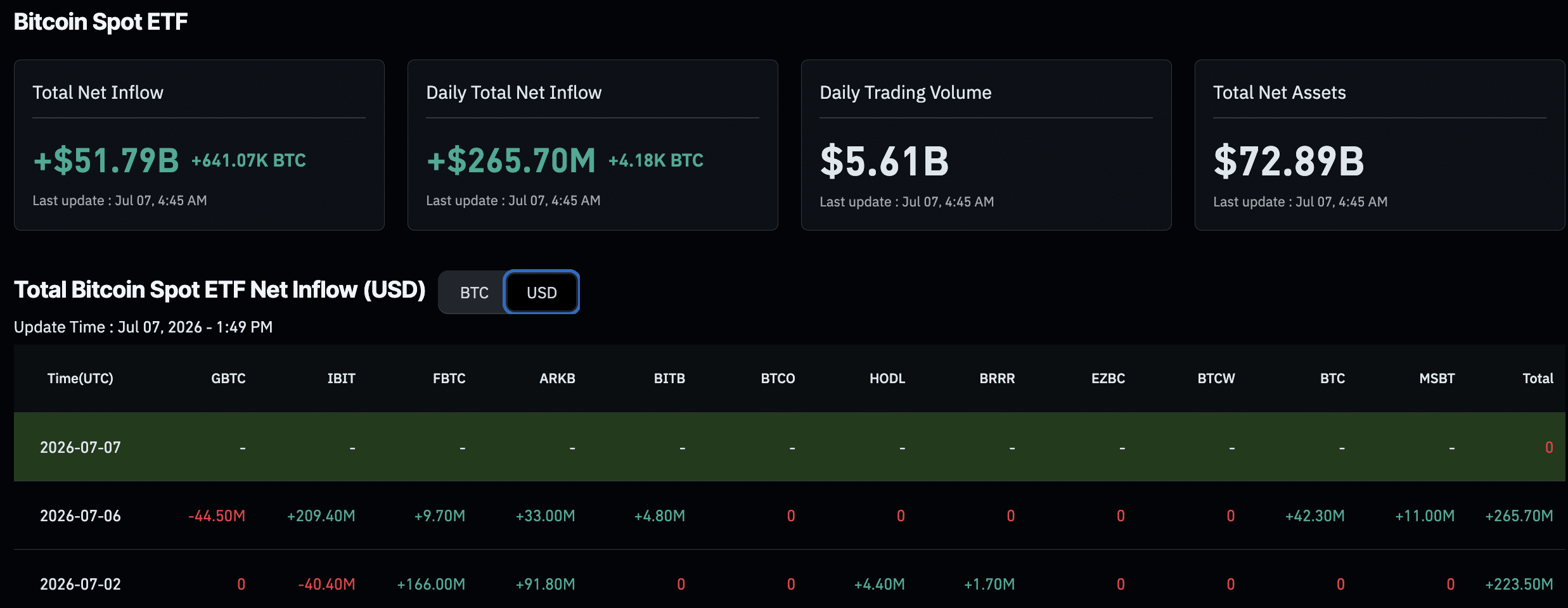
Seventeen years on, the machine has eaten its critic. America’s spot Bitcoin ETFs hold roughly 1.2 million coins, around $74Bn, more Bitcoin than the Satoshi wallet is believed to hold.
The ETF buyer owns a brokerage entry in a trust holding claims on coins parked, mostly, with one custodian, Coinbase. The phrase “Not your keys, not your coins” has been inverted at scale, politely, with a prospectus.
Above the spot layer sit futures, covered-call funds, structured notes, and corporate treasuries buying coins with convertible debt: leverage chasing scarcity, the 2007 thesis with better branding.
Analysts project ETFs may absorb more than 100 percent of new issuance this year, a worrying sign for the supposed decentralized nature of Bitcoin.
DISCOVER: Best Meme Coin ICOs to Invest in 2026
Have ETFs and BlackRock Killed Satoshi’s Vision for Bitcoin?

Has Bitcoin become what it opposed? The defense is real: the base layer cannot be bailed out, and self-custody remains open. But money is a practice, not just a protocol.
If the marginal buyer holds an IOU and the largest holders are dollar-maximizing fiduciaries, bitcoin functions as a volatility product inside the system; it protested.
Gold walked this road: demonetized, then securitized in 2004 into a five per cent allocation. But one actor never sold, wrapped, or leveraged. Between 2009 and 2010, a single miner, identified through the Patoshi pattern, accumulated an estimated 1.1 million BTC across 20,000 addresses.
None has ever moved. The only recent activity is inbound: tributes to the unspendable Genesis address, including 2.56 BTC this February. The only explanations for the lack of movement are: death, lost keys, or the biggest diamond hands in history.
But entertain a fourth, as a thought experiment rather than a claim: what if this stack is Satoshi’s kill switch? Every valuation model prices those 1.1 million coins as if they were burned.
Movement of a single Patoshi coin would be a global event; the fear that five per cent of the supply against 450 newly mined coins a day would detonate precisely the leveraged, wrapped layer while shattering the immaculate-conception myth on which institutional Bitcoin rests.
Could this be Satoshi’s Trojan horse, a genius way to kill his invention and bring the traditional finance sector to its knees once more?
EXCLUSIVE: Join 99Bitcoin’s $1000 USDT Airdrop on ByBit
The Silence From Satoshi is Getting Louder
Bitcoin Experts Split on Freezing Satoshi's 1.1M BTC · TFTC
Unpopular opinion: I would support defending the network and freezing dormant Bitcoin. Fight me. https://t.co/5wXsQuN6pB
— Julian ₿oring (@julianboring) July 5, 2026
The objections deserve equal force. The Strangelove problem: a secret doomsday machine deters nobody, and Satoshi announced nothing, unless ambiguity is the mechanism, a permanent tail risk in every institutional memo.
The problem with this thought experiment is that a crash punishes small-time investors while institutions buy the dip at a huge discount.
There is also a deadline attached to the 1.1M BTC Satoshi wallet; the coins sit in quantum-exposed early-tech wallets, and developers are already debating freezing such coins, which could lead the network to confiscate its founder’s stash to save itself.
Death remains likelier than design. Yet the deterrent functions whether intended or not; game theory needs a possibility, not a player.
The wallet need not be a kill switch on purpose. In a system this reflexive, it only has to be one potentially. So, the protocol has not become what it opposed; the practice largely has.
Bitcoin set out as an exit and became finance’s best product; the chain whose first block mocks bailouts now anchors a fund complex custodied mainly at one company.
By the founder’s own metrics, trust required, intermediaries removed, moral hazard starved, it is losing while the price chart wins. Its greatest success is its ideological failure.
Yet the indictment cannot be deleted: every ETF share resolves to a ledger whose first entry condemns its custodians. And the silence endures, the only part of Bitcoin unchanged since 2009.
The most consequential thing Satoshi did after inventing Bitcoin was nothing, seventeen years of it, at a cost of $80Bn. Everyone else has been doing something. Perhaps that was the warning all along.
EXPLORE: Best Crypto Presales With Asymmetric Upside in the Current Market
The post Wall Street Swallowed Bitcoin: But Satoshi Left a $80Bn Trojan Horse Wallet appeared first on 99Bitcoins.

